Hi quest ,  welcome  |  sign in  |  registered now  |  need help ?
Hi, guest ! welcome to BREAK NEWS ONLINE. | About Us | Contact | Register | Sign In

Popular Posts

Showing posts with label Forex. Show all posts

What are Forex Currency Prices?

Written By 092505589 on Sunday, May 15, 2011 | 3:54 PM

[postlink]https://breaknewsonline.blogspot.com/2011/05/what-are-forex-currency-prices.html[/postlink]Currency is the basic unit used mainly for the exchange of goods and services. There are several different currencies used all around the world. All the countries in the world have their own currencies. There are currencies as strong as US dollar and as weak as Zimbabwean dollar. The value of a currency is necessary for forex trading.
Change in World Economy
Balancing Money and the Earth
[kawashima_umika_05_01-731756.jpg]


Previously the currencies of the world were valued on the basis of their comparison to the price of gold. The price of gold in the international market was a determinant factor in deciding the price of the currency. To maintain the price of their currency states were bound to keep reserves in the form of gold. To make it simple we can say that in the past the more gold reserves a state had the higher the price of its currency would gain.
What Laid the Foundations of Forex

With the passage of time world economy has witnessed many changes. The end of Barton Wood system changed world’s reserve system. The growth of economy required the change in world’s reserve system.

The reserved system which lied previously on gold was replaced with US dollar. Some countries are using Euro as their reserves. However most of the states have a dollar based reserve system.
The Currency Prices

The prices of foreign currencies are referred to as forex or FX in international market. The currency exchange is also known as foreign exchange. These currencies are compared mainly in pairs. The aim is to determine which currency has more value as compare to the other currency. The major pairs are US dollar against the Japanese yen, and/or the British pound against the European euro. US, Britain, Japan, Europe and some other states fall into the category of great economic zones. The currencies of great economic zones are needed worldwide for trade. The Australian dollar, Swiss franc, and Canadian dollar also fall in the category currencies of great economic zones. Hence, the forex currencies of these states are traded in the international banks.
Why Forex is Necessary

What are Forex Currency Prices

The forex is vital for many reasons. The forex currencies are necessary for international trade and commerce. Several banks and other financial institutions trade these currencies for their own benefits.

Not all the currency pairs are as strong as the pair of US dollar and Japanese yen. There weak currency pairs also exist. The pairs of US dollar and Polish zloty and Japanese yen and Thai baht are examples of weak pairs.
Currency Pairs

There is another category of currency pair, which is not used in forex as much as the strong pairs or to some extant the weak pairs. These currency pairs are known as exotic pairs. The currency pairs discussed so far are traded widely. The currencies of rest of the countries are traded for some specific purpose.

Tourists or businessmen, who need these currencies, either get them in exchange of their own currencies or trade them vis-à-vis dollar. In this method of exchange a currency is valued in dollar, and the buyer gets the currency of his need according to its value in dollar.

[kawashima_umika_05_01-731756.jpg]

How to Make and Lose a Fortune in Forex?

Written By 092505589 on Wednesday, May 11, 2011 | 3:12 PM

[postlink]https://breaknewsonline.blogspot.com/2011/05/how-to-make-and-lose-fortune-in-forex.html[/postlink]If you are looking for an online job on internet then you should consider online trading. You can earn a remarkable amount of money by forex trading. When it comes to the fastest, efficient and the most workable online trading then forex trading is the answer. Forex trading offers many benefits for traders if they get enough learning of forex trading before officially starting it. A number of features of forex trading make it is the most suitable tool to generate online money.
Useful Information about Forex Trading Market

When you consider working as a forex trader, you should gather some authentic information about forex trading market to work as an effective forex trader. Following is the useful information for you to get a quick start as a forex trader with full confidence.
Timings of Forex Market

Timings of Forex Market

Forex market remains open 24 hours a day around the world and it starts working from Sunday (afternoon/evening) till the following Friday (afternoon/evening). You can work online from anywhere in the world and become a day trader.
Risk Probability

Forex market is risky for amateur traders, but still if you learn before start working as a forex trader then you can trade effectively with low risk.
Amount of Investment

You can start your forex trading account will a very little amount of investment. This is because the technological advancements that have made it is easier for home based small investors to start online trading with only few hundred dollars.
Forex Pips

Forex market allows you to take a start with little investment and you can easily find brokers regardless of the amount you can invest. A number of brokers are always available to offer you their services.
Price Actions

You should be aware of the changes occur in price. It is obvious that you cannot know about the exact change in price but you can predict these price actions by using any analysis method.

Price actions are the reasons for the continuous working of forex market and without price fluctuations there will be no forex trading.
Currency Market

Currency Market

If you decide to trade in currency market then you can generate profit by the fluctuations occur in price. On the other hand, if you decide to trade in shares and stocks, then you have to rely only on the rising of market.
Dummy Trading Accounts

You can take a start with a dummy forex account. These accounts are being offered by the online forex brokers. You don’t have to invest real money unless you feel sure about your success in forex trading.

It is recommended to you to learn forex trading or take a course of forex trading before starting it officially. After that you should choose a system and try to stick with that system. Be persistent and train yourself to bear the ups and down of forex trading. You also have to learn from your mistake if you want generate real profits. For online trading, it is highly important for you to find an authentic website. Search a reliable forex trading system that you feel is suitable for your personality type and for your lifestyle.

Mobile Apps for Trading in Currency Markets

Written By 092505589 on Saturday, May 7, 2011 | 1:28 PM

[postlink]https://breaknewsonline.blogspot.com/2011/05/mobile-apps-for-trading-in-currency.html[/postlink]Honoka Hot Jepanese Girl
Honoka Hot Jepanese Girl


The world is changing too rapidly. When forex trading business was introduced, no one had guessed that it would spread so widely and would soon take over the world. The small and medium investors themselves feared that it would take quite long to gain popularity. However, the popularity in this short span is quite remarkable.
Forex Trading Platform

Forex Trading Platform

The apex of the forex trading came when automated Forex trading platforms were introduced. The markets took a dramatic, gigantic and tremendous turn, making the business the most sought after by investors around the globe.
Technology

As “Necessity is the mother of Invention”, so when the business took a leap, then the necessities also took rise. Thus, technology started playing its part to make the system better and better and this process of introducing new technologies is going on daily purpose.

The reward goes to the technology, which has made the business accessible by one and all from anywhere any time.
Forex and mobile phones

Mobile phones have revolutionized the world so as Forex trading. The trend of doing Forex trade through mobile phones is growing very rapidly nowadays. Investors and the traders find it very comforting to trade via mobile phones. It is because of mobile facility, that the investors and traders can manage their accounts, while on the move from any location on the face of earth.
Jack of all trades

Earlier it was quite harder for the businessmen who were doing different business to do forex trading as side business. The mobile technology has specially provided ease to those businessmen who are doing a bunch of jobs and are facing shortage of time, even though they want to be a part of forex trading. Now they can at the same time continue their business and do active forex trading.
Software

Forex Software

There is mobile trading software through which investors get all the updates on their phones around the clock, including charts and other indicators. An investor through this software can easily control as well as manage his open positions and even execute the pending orders. So, no matter how long the distance is, the investor can still make the right decisions and can do forex trading. The software is meant for those who want to take Forex trading as a part time business and for those who suffer the time problems. The trading software is a little costly and all the investors may not be able to purchase it. However, by looking into the functionalities, it is indeed need of the hour. These software’s have added glamour, color ease and fun to the Forex trading business.

The latest touch-screen models can maximize the ease of operation, making Forex trading such an easy deal just at one’s fingertips.

Best of Forex Trading Tools

[postlink]https://breaknewsonline.blogspot.com/2011/05/best-of-forex-trading-tools.html[/postlink]The introduction of Forex trading tools have made this business more simple and easy to understand for newbie’s. Actually, none of the device can be considered as ideal for the sake of currency trading. Nonetheless, the professional in this field have developed couple of practical instruments that offer a comprehensive idea about the currency market.
Tools Helps to Make Good Profit


The more skilled traders in this professional have accepted the fact that right t use of Forex trading tools will bring substantial earnings.
Forex Trading Tools Update the Knowledge of Traders

Forex Trading Tools

The Forex trading entails the swapping of international currencies and also earning money through this practice. The market of Forex trading has been scattered on geographical basis and is illustrated by large investments. The Forex trading tools facilitate the trader in getting the latest information about the market trends; hence he/she can earn more profits.
Tools Provide Daily Summaries of Important Currencies

The most vital characteristics of Forex trading tools are to supply the reviews of main currencies on daily basis. These also provide weekly reviews of the currencies besides the other main updated information about the market. This aids the traders in understanding the most recent situation of the currency market through which they evaluate the market stipulation. By having a thorough knowledge about the currency market, the traders can forecast the potential tendencies and invest accordingly.

In this regard couple of mechanical softwares has been launched as Forex trading tools. The development in technology has invented certain softwares that gather all the essential details robotically and save this information for the trader.
Easy to Analyze Currency

Currently the task of evaluating the currency has become very simple. In this regard, the novice traders particularly use these gears in practical and useful manner. These software tools can be downloaded from internet for an insignificant cost. Now you can access the latest market situation just with few mouse clicks.
Forex is One of the Biggest Trading Markets

Numerous currencies are traded on daily basis in Forex trading market. It is therefore, not an easy job to maintain the record of whole trade with the alteration in rates of different currencies.

As a vigilant trader, one must be aware of the most recent happening in the currency market. This purpose can solely be achieved with the help of Forex trading tools. It provides an immediate access to the trading reviews; else it would not be easy to acquire these reviews.
The Updated Information Makes the Decision Easier

If the trader has information about the prevailing rates as well as the daily and weekly reviews, he/she can take more appropriate decision. There are couple of more tools that assist trader to keep an eye on rates of interest.

These tools also provide them complete accessibility to the dictionary as well as the monetary almanac. All these gadgets are mandatory for Forex trading.
The Forex Trading Tools are Available at Your Home

Forex trading tools are within the reach of traders

Now these Forex trading tools are within the reach of traders in their own homes. The biggest benefit of Forex trading is flexibility of time, because the currency market is open 24 hours a day. The trading activities can be performed with the help of internet and the cash can also be relocated automatically with the help of electronic machines

If you have PC as well as the internet at your place, you will have an easy access to the Forex tools and the foreign currencies for trading. There are plentiful companies on internet that offer the functional gadgets, such as comprehensive market study for easy trading.
Online Tools Help in Saving Money

These online tools can be downloaded from internet free of cost. If a trader would like to save cash, he/she can utilize these online tools. These online companies issue financial reports and also have various discussion forums

The existing Forex graphs as well as the other covert trading information unearthed by the internet companies are also very helpful for the investors. The combinations of one’s skills with the Forex trading tools will surely make him/her triumphant.

“Currency Manipulation” Will Continue, Despite G20

Written By 092505589 on Friday, May 6, 2011 | 11:58 AM

[postlink]https://breaknewsonline.blogspot.com/2011/05/currency-manipulation-will-continue.html[/postlink]

Last month, the G20 finally agreed on the specific factors that would be used to determine whether a country was manipulating its currency. Despite being watered-down (by the usual suspects), the so-called “scorecard” is nonetheless extremely substantive. Unfortunately, the resolution will be backed only by “peer pressure,” rather than any kind of real enforcement mechanism, which means that in practice it is basically worthless.


While the proximate goal of the resolution is to eliminate exchange rate manipulation, it’s ultimate goal is to minimize the risk of another economic/financial crisis. Towards that end, a country’s “budget deficit levels, the external imbalance and private savings rates” will be closely scrutinized, and will be warned if any of these factors reach levels that are deemed to be unsustainable. The idea is that an early warning system will prevent the global economy from reaching a point of disequilibrium that is so severe that crisis would be impossible to avert.

Of course, the problems with this program are manifold. First of all, there are no concrete numbers. For example, it’s not clear how large a country’s national debt or trade deficit has to reach before it receives a phone call and slap on the wrist from the G20. In fact, you could argue that the same imbalances that precipitated the crisis are largely still in place, which means that some countries should have been warned yesterday.

Second, there is no meaningful enforcement mechanism. That means that countries that disregard the resolution don’t really have anything to fear, other than the wrath of investors. In other words, if governments and Central Banks know that they can manipulate their exchange rates with impunity, what’s to stop them? Look at Japan: its public debt is the highest in the world. It runs a perennial trade surplus. Its citizens are notorious savers. And yet, when the Yen rose to a record high, which you might expect from such an imbalanced economy, the G7 (in this case) took the unusual step of pushing the Yen down. I’m not saying this wasn’t the right thing to do, but what kind of signal does this send to other rule breakers.

While all emerging market countries took an active interest in exchange rates (and seek to exert some control over their currencies), China is certainly Public Enemy #1, and is the clear target of the “currency manipulation” talk. To its credit, the People’s Bank of China (PBOC) has permitted the Chinese Yuan to appreciate 20% against the Dollar (probably 30% when inflation is taken into account) over the last few years. Meanwhile, both internal government statisticians and the IMF expect its current account surplus to narrow to a mere 5% in 2011, as its economy slowly rebalances.

In this sense, I think China is a case in point that the best enforcement mechanism is reality. Specifically, China has reached a point where it cannot continue to pursue an economic policy based on exports, without spurring inflation and causing the inefficient allocation of domestic capital (such as in real estate). It must raise interest rates and accept the continued appreciation of the RMB is an unavoidable byproduct.

The same goes for other countries that attempt to hold their currencies down. If they can get away with it, then so be it. If not, I can guarantee that it won’t be the G20 that forces them to change.

Does Japan’s “Triple Disaster” Threaten the Dollar?

[postlink]https://breaknewsonline.blogspot.com/2011/05/does-japans-triple-disaster-threaten.html[/postlink]
While analysts have been busy dissecting the implications of the natural disasters that ravage(d) Japan for forex markets, the focus has naturally been directed towards the Yen. Given all the rumors about the liquidation of foreign (i.e. Dollar-denominated) assets, it’s also worth examining the potential impact on the Dollar. In a nutshell, Japan’s holdings of US Treasury Securities are extensive, and even a partial unloading could have serious
implications for the world’s de facto reserve currency.
As I explained in my previous post, the Yen rose to a record high (against the Dollar) following the earthquake/tsunami/nuclear crisis because of rumors that Japanese insurance companies and other financial institutions would begin repatriating all of their foreign assets in order to pay for rebuilding. (For the record, it’s worth pointing out again that this has yet to take place, and any repatriation is probably related to the approaching fiscal-year end. Thus, the Yen is being propelled by speculation/short squeeze. Period.)
Indeed, Goldman  Sachs has estimated that the rebuilding effort will probably cost around $200 Billion. A significant portion of this will no doubt be covered by the payout of insurance claims. How insurance companies will make their claims is of course, unknown. However, consider that Japanese insurance companies have insisted that they have ample cash reserves. In addition, Japan has what is perhaps the world’s most solid earthquake reinsurance (basically insurance for insurers) program, which means primary insurance companies can basically pass these claims up the chain, perhaps all the way to the government.
As for whether the Bank of Japan will sell some its $900 Billion in Treasury holdings, this, too appears unlikely. First of all, the Bank of Japan is doing everything in its power to soften the upward pressure on the Yen, which would not be consistent with selling any of its Dollar-assets. Second,  the Financial Times has further argued that they will be especially unlikely to sell US Treasury securities, because they would lose money on (US Dollar) currency depreciation. Besides, any assets that are sold now to pay for rebuilding would probably need to be repurchased later in order to restore balance sheet equilibrium.
While I am on the topic, I want to draw attention to a recent Treasury report that documented the overseas holdings of Treasury securities. The major surprise was China, whose holdings were revised upwards to $1.18 Trillion (from $892 Billion), which means it is well-entrenched as the most important creditor to the US. However, this was offset by a 50% drop in the Bank of England’s holdings, caused perhaps by a change from US debt to British debt.
As I have written in the past, it seems unlikely – for political, economic, and financial – reasons that China will move to pare its Treasury holdings in a significant way. Simply, it has no other viable options for investing the foreign exchange reserves that it is forced to accumulate because of the Yuan-Dollar peg. Other doomsdays have speculated that the crisis in the Middle East will end the “petro-Dollar” phenomenon, whereby oil exporters settle their bills almost exclusively in Dollars and use the proceeds to buy Treasuries. While US influence in the Mid East may indeed wane further as a result of the ongoing political turmoil, I don’t think this will force a change to the PetroDollar phenomenon, which is due as much to unavoidable trade surpluses as it is to settling oil transactions in US Dollars.
There is certainly some concern about what will happen when the Fed wraps up QE2 later this year and stops buying Trreasury securities. Two prominent investment companies (PIMCO and Vanguard) have warned that this will cause bond prices to fall and interest rates on debt to rise rapidly. While this is certainly possible, demand for Treasuries will remain strong for as long as the current risk-averse climate remains in place. In addition, given that the US Treasury is not in danger of defaulting anytime soon, yields reflect expectations for inflation and interest rates more than supply/demand for the bonds themselves. Finally, when the Fed stopped buying mortgage backed securities in 2010, mortgage rates fell, contrary to expectations.
In short, the Dollar might continue to fall against the Yen as speculators cover their short positions, but not because of any fundamental reasons. On an aggregate basis, the never-ending string of crises won’t cause the Dollar to collapse. If anything, it might even bring some risk-averse capital back to the US and re-affirm the Dollar’s status as global reserve currency.

How to Trade In 2011?

Written By 092505589 on Tuesday, May 3, 2011 | 10:58 AM

[postlink]https://breaknewsonline.blogspot.com/2011/05/how-to-trade-in-2011.html[/postlink]Kuninaka Ryoko
One of the basic and foremost instincts of a human being is to earn more and more profits. Making a profit greatly depends upon market conditions and general tactics. There are some useful steps which if being followed will help a lot, in understanding  the chemistry of these marketing conditions and to get some consistent profits from forex trading.

Day Traders

Most of us prefer being day traders, and it is the utmost desire and necessity to earn some profit by the end of the day. Being an efficient day trader, for instance, one should have in mind the average daily range for each of major currency pairs. In the last three months, most of the leading pairs have noticed their averages fall quite rapidly as indicated by the Average True Range indicator.
So, if the same trend continues, it leads to smaller and smaller trading range at the end of each day.

Necessary Precautions

As for those who don’t know, by the end of December 2010 the average range of the GBP /USD pair was 135 points at the time of writing. People, who enjoy early morning breakouts, must be cautious about trading early in the morning by taking in consideration of overnight trading points range. Moreover, if the range is between 30 to 60 points and breakout takes place, then there is plenty of room for the price to move strongly in the expected direction. This is the same situation when the trading range was in excess of 200 points, and we were sure about the price heading towards the right destination.

Longer Term Trades

Long term trades are always more reliable than the short term trades. Most of the traders are busy trying to get quick profits. However, it is quite a known fact that trading ranges are quite minor now a day’s for major pairs. Usually most of us are far much better off trading the four hour and daily charts. The overall trend, forex trading system uses the daily chart and the four hour chart for pinpointing entry and exit points.

This has worked marvelously for quite a long time, and there is nothing stopping forex from being more profitable in the upcoming years.

Making Money Is Simple

Making Money Is Simple
The major pairs will always confirm very well to technical analysis on these longer time frames. Overall it is a lot easier and quite efficient way to make money. You simply need to come up with a straight-forward trading system that can detect one or two high probability trading opportunities every week.
The crust of the whole scenario is that let the previous and bygones be left aside, there are still plenty of opportunities to make money from forex trading in 2011. This is true if you enjoy the bounty of trading the longer term charts. However, short term trading can also be fruitful despite the narrow trading ranges. We have to look a bit deep and find the right method, which leads to efficient trading.

Forex Becomes A Mass Movement

[postlink]https://breaknewsonline.blogspot.com/2011/05/forex-becomes-mass-movement.html[/postlink]
The market isn’t getting any more efficient is the first warning essential for all future forex traders The fashion among retail investors these days is to trade foreign exchange Before the trend catches on to you as well, note the fact that the FX market is unpredictable now, making it impossible to capitalize the same as an easy money generator.To confirm the same the test of an efficient market, volatility ratios, can be done. Thank you for reading about foreign exchange and foreign exchange.


The process involved is basic. If markets are to be efficient, past price movements shouldn’t predict future movements, but this is just one of the conditions. For this scenario the rise in volatility is proportionate to the square root of time, hence the volatility of fortnightly change is the same as the square root of two multiplied by the weekly volatility.


If we test the volatility of actual to random walk, we can see whether a price follows random walk or not. A higher random walk volatility than actual volatility translates into falls in one period leading to rises in the eventual period.


The ratio of actual to random walk volaitility for three main exchange rates can be seen in my chart. The pound may rise for a few weeks but would fall because of reversion is the suggestion here Further your knowledge on foreign exchange at currency conversion calculator.


Nevertheless, the ratios touch one, as close as 12 percent of it. One could easily lose fortunes bettinf on the inefficiency since it is so little. The diminishing profit making became staple of Forex trading in the 1990s since investors started wising up to the momentum effects.


One can see deviations over a short period of time from the random walk. Anticipating surprises better than the market can lead to a person making money even from a random walk. Our data findings show a roughly random rate move for foreign exchange over a 17 year period. The efficiency of a market would be brought down in extremely short periods.


For traders, knowing news like the US dollar turning absolutlely worthless in an years time would be priceless. It would have been possible to make money by purchasing the dollar at its lower point because it over reacted and then mean reverted.


But this is not an inefficient market. The profits made from purchasing dollar at its low point aren’t risk free ones but instead a reward for taking the crash risk. The predominant character in exchange rates over the years is the variation in crash risk.


It is obvious that the

“Currency Manipulation” Will Continue, Despite G20

Written By 092505589 on Sunday, May 1, 2011 | 9:11 PM

[postlink]https://breaknewsonline.blogspot.com/2011/05/currency-manipulation-will-continue_01.html[/postlink]Last month, the G20 finally agreed on the specific factors that would be used to determine whether a country was manipulating its currency. Despite being watered-down (by the usual suspects), the so-called “scorecard” is nonetheless extremely substantive. Unfortunately, the resolution will be backed only by “peer pressure,” rather than any kind of real enforcement mechanism, which means that in practice it is basically worthless.


While the proximate goal of the resolution is to eliminate exchange rate manipulation, it’s ultimate goal is to minimize the risk of another economic/financial crisis. Towards that end, a country’s “budget deficit levels, the external imbalance and private savings rates” will be closely scrutinized, and will be warned if any of these factors reach levels that are deemed to be unsustainable. The idea is that an early warning system will prevent the global economy from reaching a point of disequilibrium that is so severe that crisis would be impossible to avert.

Of course, the problems with this program are manifold. First of all, there are no concrete numbers. For example, it’s not clear how large a country’s national debt or trade deficit has to reach before it receives a phone call and slap on the wrist from the G20. In fact, you could argue that the same imbalances that precipitated the crisis are largely still in place, which means that some countries should have been warned yesterday.

Second, there is no meaningful enforcement mechanism. That means that countries that disregard the resolution don’t really have anything to fear, other than the wrath of investors. In other words, if governments and Central Banks know that they can manipulate their exchange rates with impunity, what’s to stop them? Look at Japan: its public debt is the highest in the world. It runs a perennial trade surplus. Its citizens are notorious savers. And yet, when the Yen rose to a record high, which you might expect from such an imbalanced economy, the G7 (in this case) took the unusual step of pushing the Yen down. I’m not saying this wasn’t the right thing to do, but what kind of signal does this send to other rule breakers.

While all emerging market countries took an active interest in exchange rates (and seek to exert some control over their currencies), China is certainly Public Enemy #1, and is the clear target of the “currency manipulation” talk. To its credit, the People’s Bank of China (PBOC) has permitted the Chinese Yuan to appreciate 20% against the Dollar (probably 30% when inflation is taken into account) over the last few years. Meanwhile, both internal government statisticians and the IMF expect its current account surplus to narrow to a mere 5% in 2011, as its economy slowly rebalances.

In this sense, I think China is a case in point that the best enforcement mechanism is reality. Specifically, China has reached a point where it cannot continue to pursue an economic policy based on exports, without spurring inflation and causing the inefficient allocation of domestic capital (such as in real estate). It must raise interest rates and accept the continued appreciation of the RMB is an unavoidable byproduct.

The same goes for other countries that attempt to hold their currencies down. If they can get away with it, then so be it. If not, I can guarantee that it won’t be the G20 that forces them to change.

Does Japan’s “Triple Disaster” Threaten the Dollar?

[postlink]https://breaknewsonline.blogspot.com/2011/05/does-japans-triple-disaster-threaten_01.html[/postlink]

While analysts have been busy dissecting the implications of the natural disasters that ravage(d) Japan for forex markets, the focus has naturally been directed towards the Yen. Given all the rumors about the liquidation of foreign (i.e. Dollar-denominated) assets, it’s also worth examining the potential impact on the Dollar. In a nutshell, Japan’s holdings of US Treasury Securities are extensive, and even a partial unloading could have serious
implications for the world’s de facto reserve currency.
As I explained in my previous post, the Yen rose to a record high (against the Dollar) following the earthquake/tsunami/nuclear crisis because of rumors that Japanese insurance companies and other financial institutions would begin repatriating all of their foreign assets in order to pay for rebuilding. (For the record, it’s worth pointing out again that this has yet to take place, and any repatriation is probably related to the approaching fiscal-year end. Thus, the Yen is being propelled by speculation/short squeeze. Period.)
Indeed, Goldman  Sachs has estimated that the rebuilding effort will probably cost around $200 Billion. A significant portion of this will no doubt be covered by the payout of insurance claims. How insurance companies will make their claims is of course, unknown. However, consider that Japanese insurance companies have insisted that they have ample cash reserves. In addition, Japan has what is perhaps the world’s most solid earthquake reinsurance (basically insurance for insurers) program, which means primary insurance companies can basically pass these claims up the chain, perhaps all the way to the government.
As for whether the Bank of Japan will sell some its $900 Billion in Treasury holdings, this, too appears unlikely. First of all, the Bank of Japan is doing everything in its power to soften the upward pressure on the Yen, which would not be consistent with selling any of its Dollar-assets. Second,  the Financial Times has further argued that they will be especially unlikely to sell US Treasury securities, because they would lose money on (US Dollar) currency depreciation. Besides, any assets that are sold now to pay for rebuilding would probably need to be repurchased later in order to restore balance sheet equilibrium.
While I am on the topic, I want to draw attention to a recent Treasury report that documented the overseas holdings of Treasury securities. The major surprise was China, whose holdings were revised upwards to $1.18 Trillion (from $892 Billion), which means it is well-entrenched as the most important creditor to the US. However, this was offset by a 50% drop in the Bank of England’s holdings, caused perhaps by a change from US debt to British debt.
As I have written in the past, it seems unlikely – for political, economic, and financial – reasons that China will move to pare its Treasury holdings in a significant way. Simply, it has no other viable options for investing the foreign exchange reserves that it is forced to accumulate because of the Yuan-Dollar peg. Other doomsdays have speculated that the crisis in the Middle East will end the “petro-Dollar” phenomenon, whereby oil exporters settle their bills almost exclusively in Dollars and use the proceeds to buy Treasuries. While US influence in the Mid East may indeed wane further as a result of the ongoing political turmoil, I don’t think this will force a change to the PetroDollar phenomenon, which is due as much to unavoidable trade surpluses as it is to settling oil transactions in US Dollars.
There is certainly some concern about what will happen when the Fed wraps up QE2 later this year and stops buying Trreasury securities. Two prominent investment companies (PIMCO and Vanguard) have warned that this will cause bond prices to fall and interest rates on debt to rise rapidly. While this is certainly possible, demand for Treasuries will remain strong for as long as the current risk-averse climate remains in place. In addition, given that the US Treasury is not in danger of defaulting anytime soon, yields reflect expectations for inflation and interest rates more than supply/demand for the bonds themselves. Finally, when the Fed stopped buying mortgage backed securities in 2010, mortgage rates fell, contrary to expectations.
In short, the Dollar might continue to fall against the Yen as speculators cover their short positions, but not because of any fundamental reasons. On an aggregate basis, the never-ending string of crises won’t cause the Dollar to collapse. If anything, it might even bring some risk-averse capital back to the US and re-affirm the Dollar’s status as global reserve currency.

Foreign Exchange Spreads

Written By 092505589 on Friday, April 29, 2011 | 8:56 PM

[postlink]https://breaknewsonline.blogspot.com/2011/04/foreign-exchange-spreads.html[/postlink]The concept of spreads in the forex trading market is extremely complicated and difficult to understand. However, it is also a fact that it is an important and inevitable parameter that determines your ability to make remarkable profits.
What is Spread in Forex Trading?


Spread in Forex Trading

In the forex market, spreads are the difference between the offer prices and the bidding prices that are quoted in pips. For instance, the quote of GBP/USD is 1.8281/84 which means that the bidding price of GBP is 1.8281 US dollar while the offer price is 1.8284 US dollar. In this particular case, the spread is 3 pips.
Role of Spread in Forex Trading

Spread is an important parameter that helps brokers to make profit in forex trading. Wider spreads indicate a high offer price and a low bidding price. This simply means that you have to pay more when you buy and make fewer amounts when you sell out, this property makes the realization and estimation of profit difficult for forex traders.
Spreads & Trading Skills

The return which you get on your trading skills is greatly affected by the spreads. Being a trader, your ultimate goal is to make profit by buying low and selling high. Traders usually take a half-pip lower spread as granted, but in reality it can make an effective trading strategy into an ineffective strategy.

Spreads & Execution

You can achieve stability and success with spreads only if you work with appropriate execution. The quality of execution identifies whether you are going to get tight spreads or not. You must be aware of the denied trades, slippage, delayed execution and stop hunting which nullifies the effects of tight spread forex trade.

You must always take forex spread into consideration with the depth of the book. In most cases, forex brokers provide tight spreads only for capped trading volumes which are totally inappropriate for the traditional forex trading strategies.
What Forex Brokers Claim?

Tight Spreads

At present, almost all forex brokers claim that they are having the tightest spreads in the forex industry. However, spread terms and policies vary remarkably from one forex broker to another, besides the transactions that are not clear. Some brokers offer non-variable spreads that remain unchanged regardless of the quality of the liquidity of forex market. However, non-variable spreads are usually higher than that of the variable spreads.

Some other brokers provide variable spreads in accordance with the liquidity of market. For such brokers, spreads become tighter when the market liquidity is at good level, however, it widens when the market liquidity falls. There are various brokers who provide different spreads for different forex traders.

Forex traders who are having larger forex accounts or others, who carry out big trades, may get tighter spreads than other traders. Therefore, it is a wise idea to seek for a broker who is offering you the tightest variable spreads without any discrimination.

An Introduction to Forex Trading

[postlink]https://breaknewsonline.blogspot.com/2011/04/introduction-to-forex-trading.html[/postlink]

One might think forex trading is a piece of cake until they enter in it seriously. Beginner forex traders must work hard to achieve real success in forex market as a beginner. Beginners must follow effective strategies; they must acquire effective money management skills and gain complete knowledge about forex trading.


Beginners Forex Lessons

If you are starting your forex trading beginners for very first time then you should take help from beginner forex lessons. This is because there is a huge traffic of forex beginner traders because of the incorporation of convenient and welcoming ways to join forex trading. Forex trading market is growing rapidly and its annual turnover is 1.9 million USD. Beginners should not take it easy. Beginner forex lessons will help forex traders to understand the buying and selling processes in forex market. In forex market, currency exchange trading occurs in pairs and at the same time buying and selling occurs.

Starters Forex

If you are starting forex trading with a starter forex then you must know about the rules of forex trading business. Particularly, you should know the basics of the buying and selling different currencies. According to recent surveys, government or companies that buy or sell their services and products daily in other countries constitute over 5% of the total profit generated in forex market. On the other hand, the remaining 95% profit is contributed by the speculation methods.

Dominant Currency Pairs

Beginner forex is a great helping tool for amateur traders. It provides them information about the perfect currency pairs that are dominating the forex trading market.

The actual dominating currency pairs in forex market are listed below.

  • USD-CAD
  • EUR-USD
  • NZD New Zealand Dollar-USD
  • USD-CHF Swiss Franc
  • AUD Australian Dollar-USD
  • USD-JPY
  • GBP-USD

Forex Quote

Forex Quote

Beginner forex will help you to read the forex quote. Basically, forex quote comprises of two numbers. These numbers are bid and offer. The best way to understand forex quote is to use the currency pair. For instance, consider the currency pair AUD/USD. The cost offered by the Australian dollar will act as the bidding price and it will be used by the traders as a price to buy the Australian dollar against the USD.

On the contrary, the price that is offered by the US dollar will act as the offer price and it will be used by the traders to sell the Australian dollar against the other i.e. USD. At 1 point, the base price value is taken in forex trading.

What is expected from Beginner Traders?

  • Beginner forex traders must acquire right approach while working in forex trading. This is a beginner forex is all about; it helps beginners to understand the two approaches of forex trading. These two approaches include two different analysis methods. Beginner forex traders should either work with fundamental or technical analysis.
  • Beginner trader should also make contact with a genuine forex pips to get effective and correct guidance.
  • Beginner traders should also acquire correct risk and management skills.

Forex Pivot Point Calculators

[postlink]https://breaknewsonline.blogspot.com/2011/04/forex-pivot-point-calculators.html[/postlink]
In the Forex trading the technique of Pivot has been used for an extended time period. The trader used to apply this strategy to develop a thought process on the market path with the help of some easy computations


Forex Pivot Point

Forex Pivot Point
The Forex pivot point is actually the echelon where the path of market alters for a particular day. This is calculated with the application of easy arithmetic formulas. Besides this, the preceding day’s high, low and close points are also taken into consideration
These points can offer decisive support and resistance levels. Hence the pivot level, support and resistance levels computed with the help of these points jointly denoted by the terminology of pivot points.

Popularity of Pivot Points in Forex Market

The pivot points are well liked in the Forex trading market, because they offer the market prognosis.
You can apply the preceding day details to compute the prospective turning points on the existing day. Since large number of traders track these pivot points, hence the market generally respond at these levels.

Forex Pivot Calculator

Forex Pivot Calculator
Pivot point can be considered as an echelon where the traders response alters from bull to bear (bull and bear are the market terms to depict high and low activity). The computation of Forex pivot is not difficult at all. In fact, you will be able to locate a number of pivot calculators available on internet. With the help of these calculators, you can very quickly calculate the pivot point. The formula to compute pivot point is pretty easy
Resistance 3 = High + 2 ´ (Pivot – Low)
Resistance 2 = Pivot + (R1 – S1)
Resistance 1 = 2 ´ Pivot – Low
Pivot Point = (High + Close + Low )/3
Support 1 = 2 ´ Pivot – High
Support 2 = Pivot – (R1 – S1)
Support 3 = Low – 2 ´ (High – Pivot)
Hence, with the help of this Forex pivot calculator, if you have the following points
High Point: 1.2297
Low Point: 1.2213
Close Point: 1.2249
You will get the following figures with the above given formula
Resistance 3 = 1.2377
Resistance 2 = 1.2337
Resistance 1 = 1.2293
Pivot Point = 1.2253
Support 1 = 1.2209
Support 2 = 1.2169
Support 3 = 1.2125

What does it indicate?

Keeping in view the above, if you acquire the preceding day’s high, low and close levels, you will obtain 7 points, i.e. three support levels, three resistance levels and one actual pivot point. If the market starts at more than the pivot point, then it signifies an extensive trading activity for that day. If market starts less than the pivot point, then short trades can be predicted on that day
Pivot points are the frequently utilized initiators for trading systems. If you have Forex pivot calculator, then you will find a great deal of assistance in your trading activities.
The Forex market has no specific opening or closing times; hence the most practical solution to consider the opening of market at 00:00 GMT (Greenwich Mean Time) and closing at 23:59 GMT.

Icelandic Kronur: Lessons from a Failed Carry Trade

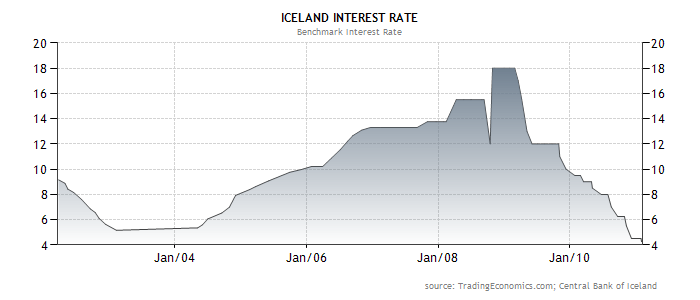
[postlink]https://breaknewsonline.blogspot.com/2011/04/icelandic-kronur-lessons-from-failed_29.html[/postlink]A little more than two years ago, the Icelandic Kronur was one of the hottest currencies in the world. Thanks to a benchmark interest rate of 18%, the Kronur had particular appeal for carry traders, who worried not about the inherent risks of such a strategy. Shortly thereafter, the Kronur (as well as Iceland’s economy and banking sector) came crashing down, and many traders were wiped out. Now that a couple of years have passed, it’s probably worth reflecting on this turn of events.


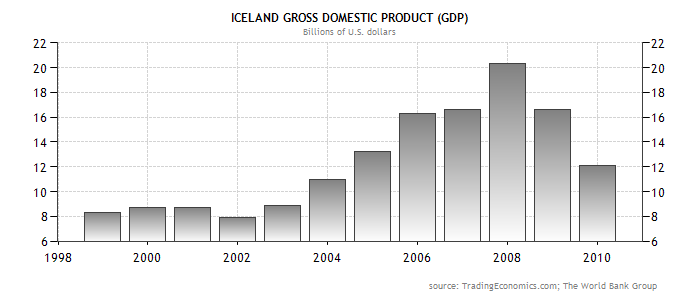
At its peak, nominal GDP was a relatively modest $20 Billion, sandwiched between Nepal and Turkmenistan in the global GDP rankings. Its population is only 300,000, its current account has been mired in persistent deficit, and its Central Bank boasts a mere $8 Billion in foreign exchange reserves. That being the case, why did investors flock to Iceland and not Turkmenistan?
The short answer to that question is interest rates. As I said, Iceland’s benchmark interest rate exceeded 18% at its peak. There are plenty of countries that offered similarly high interest rates, but Iceland was somehow perceived as being more stable. While it didn’t apply to join the European Union (its application is still pending) until last year, Iceland has always benefited from its association with Europe in general, and Scandinavia in particular. Thanks to per capita GDP of $38,000 per person, its reputation as a stable, advanced economy was not unwarranted.
On the other hand, Iceland has always struggled with high inflation, which means its interest rates were never very high in real terms. In addition, the deregulation of its financial sector opened the door for its banks to take huge risks with deposits. Basically, depositors – many from outside the country – parked their savings in Icelandic banks, which turned around and invested the money in high-yield / high-risk ventures. When the credit crisis struck, its banks were quickly wiped out, and the government chose not to follow in the footsteps of other governments and bail them out.

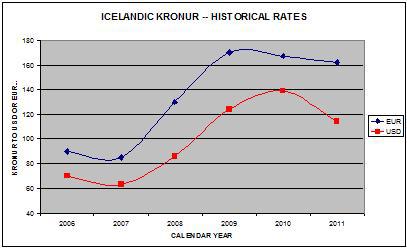
Moreover, it doesn’t look like Iceland will regain its luster any time soon. Its economy has shrunk by 40% over the last two years, and one prominent economist has estimated that it will take 7-10 years for it to fully recover. Unemployment and inflation remain high even though interest rates have been cut to 4.25% – a record low. The Kronur has lost 50% of its value against the Dollar and the Euro, the stock market has been decimated, and the recent decision to not remunerate Dutch and British insurance companies that lost money in Iceland’s crash will only serve to further spook foreign investors. In short, while the Kronur will probably recover some of its value over the next few years (aided by the possibility of joining the Euro), it probably won’t find itself on the radar screens of carry traders anytime soon.
In hindsight, Iceland’s economy was an accident waiting to happen, and the global financial crisis only magnified the problem. With Iceland – as well as a dozen other currencies and securities – investors believed they had found the proverbial free lunch. After all, where else could you earn an 18% by putting money in a savings account? Never mind that inflation was just as high; with the Kronur rising, carry traders felt assured that they would make a tidy profit on any funds deposited in Iceland.
The collapse of the Kronur, however, has shown us that the carry trade is anything but risk-free. In fact, 18% is more than what lenders to Greece and Ireland can expect to earn, which means that it is ultimately a very risky investment. In this case, the 18% that was being paid to depositors were generated by making very risky investments. As the negotiations with the insurance companies have revealed, depositors had nothing protecting them from bank failure, which is ultimately what happened.
Now that the carry trade is making a comeback, it’s probably a good time to take a step back and re-assess the risks of such a strategy. Even if Iceland proves to be an extreme case – since most countries won’t let their banks fail – traders must still acknowledge the possibility of massive currency depreciation. In other words, even if the deposits themselves are guaranteed, there is an ever-present risk that converting that deposit back into one’s home currency will result in losses. That’s especially true for a currency that is as illiquid as the Kronur (so illiquid that it took me a while to even find a reliable quote!), and is susceptible to liquidity crunches and short squeezes.
When you enter into a carry trade, understand that a spike in volatility could wipe out all of your profits in one session. The only way to minimize your risk is to hedge your exposure.

Forex Ambush

Written By 092505589 on Wednesday, April 27, 2011 | 12:32 AM

[postlink]https://breaknewsonline.blogspot.com/2011/04/forex-ambush.html[/postlink]Forex Ambush 2.0 relies on technologies which was a lengthy time within the creating – developed by a group of 31 skilled traders, back-tested, retested – and continuously upgraded and evolved until the Forex Ambush 2.0 produced 100% accurate outcomes consistently to the satisfaction of Forex Ambush 2.0. As the Foreign Exchange currency market fluctuates, often quite a few times in each day, Forex Ambush 2.0 send out signals to its members, either by e-mail or by SMS, advising regardless of whether to sell or obtain based on the signal. These signals take place in real time, as the currency fluctuation happens and as Forex Ambush 2.0 actually trades.


The actual signals from Forex Ambush Software translate into “pips” and, since the signals are occurring at the precise minute that Forex Ambush 2.0 trades, you must be at your pc to access these signals and act upon them – should you opt for to do so. If your mobile phone is able to support the Forex software program, you can obtain the Forex Ambush 2.0 signals on your cell phone anywhere within the world and act on the signals received.

When trading in Foreign Exchange markets (Forex), the currency will be the “pip”. Forex Ambush 2.0 supports a trailing pip of 5, but some Forex software won’t support a trailing pip of below 15. Forex Ambush 2.0 have, nevertheless, thought of this and factored it in, with “expert advisor” software program which might be installed separately. This software program was developed for MetaTrader employing a 5 pip trailing quit.

Forex Ambush 2.0 function with a 5 pip trailing profit along with a 20 pip take profit. Stop loss just isn’t utilized with Forex Ambush 2.0. Fundamentally, without having going into too much confusing detail, if the signal falls between five pips and 20 pips, Forex Ambush 2.0 advises you to trade. If it falls outside of that, Forex Ambush 2.0 advises you not to trade. Basically, the automated trailing stop as well as the take profit will close the trade for you. Forex Ambush 2.0 advises you to by no means close a trade manually – leave your Forex software program running and your pc on and Forex Ambush 2.0 Software is developed to do the rest.

Is the Kiwi the Most Overvalued Currency?

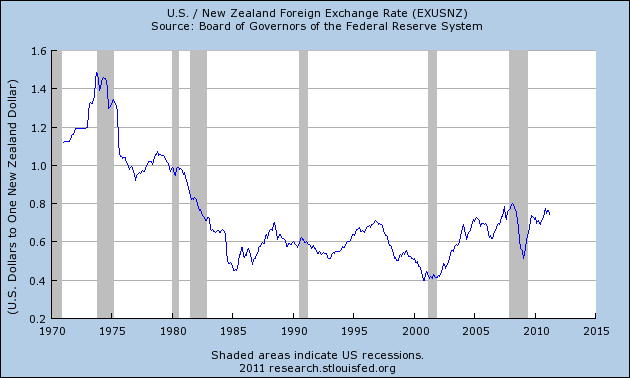
[postlink]https://breaknewsonline.blogspot.com/2011/04/is-kiwi-most-overvalued-currency.html[/postlink]During recent interviews with the Forex Blog, both Mike Kulej of FX Madness and the team at Action Forex imparted their beliefs that the New Zealand Dollar is currently the world’s most undervalued currency. Since I hadn’t written about the Kiwi in a few months, I decide to some research, ad came to a slightly different conclusion. In keeping with the spirit of debate, I’d like to defend the opposite premise- that the New Zealand Dollar is now one of the world’s most overvalued currencies.
Suzuki Akane On Hot Asian Gallery


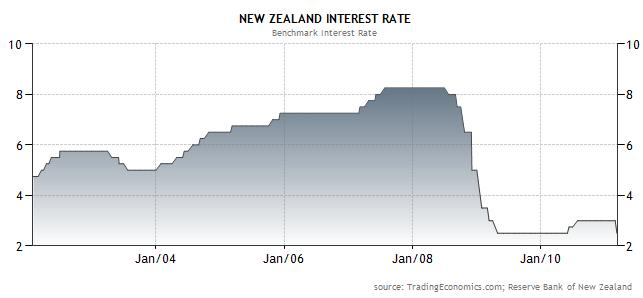
There are two principal reasons for the Kiwi’s perennial appeal with forex traders. First, New Zealand frequently boasts some of the highest interest rates in the industrialized world. Before the credit bubble burst, New Zealand’s benchmark interest rate was a whopping 8.25%. Moreover, because of its association with Australia, investors are quick to ascribe to it (dubiously) a greater sense of security than they would to emerging market economies with similarly high interest rates. For example, while Brazilian rates are usually higher, the markets less apt to lump the Real together with the Australian Dollar, even though it’s arguably a closer fit than the Kiwi.
While it’s hard to predict New Zealand trade dynamics, we can say with relative certainty real interest rate levels will remain low for the foreseeable future. Two recent earthquakes have threatened an economy that is already in trouble (projected GDP growth in 2011 is only 1.3%). Over the next 12 months, the markets have priced in only 50 basis points in rate hikes. “Nothing here will change the RBNZ’s intentions to keep monetary policy at ‘emergency’ levels for the rest of this year,” summarized one analyst. Meanwhile, the CPI rate is currently at 4.5%, and is generally tracking commodities prices higher.
Thus, it is continually one of the most popular target currencies for carry trades. The extent of this phenomenon is such that turnover in the Kiwi is 100x greater than its GDP would imply. As I pointed out in an earlier post, this is the highest ratio of any currency in the world. In fact, “Dr Alan Bollard, Governor of the Reserve Bank [of New Zealand], once described it as an international standard of value that just happens to be used by a small country as its money.”
The credit crisis should have shattered the myth of the NZD as a stable currency, since the NZD lost 50% of its value in a matter of months. In addition, the benchmark rate has been lowered to 2.5%, a record low. When you take inflation into account, the rate is -2%, which as far as I know, is among the lowest in the world. When you factor in consecutive budget deficits for the first time in two decades and the (unrelated) explosion in public debt, it baffles me that yield seekers would still be interested in holding the Kiwi.


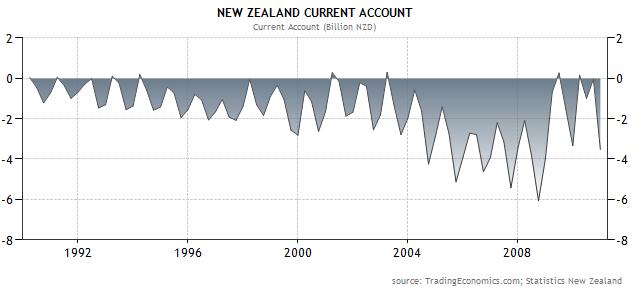
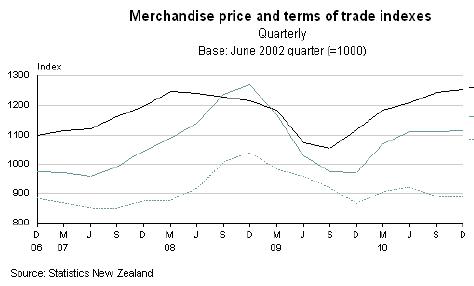
The other source of strength is the perception that the Kiwi is a commodity currency. To be fair, the production and export of agricultural products (dairy, meat, wool, etc.) makes a significant contribution to New Zealand’s economy. In addition, the prices for such agricultural staples have been rising faster than prices for imported goods, to the extent that the terms of trade have widened further in New Zealand’s favor. Unfortunately, this is ultimately irrelevant, since the aggregate balance of trade is currently in deficit, where it has stood for most of the last decade. If prices for energy and traditional commodities continues to rise, the current account deficit would at risk for eclipsing the record 6% set in 2008.

With all of this in mind, it’s tough to understand how the New Zealand Dollar could be closing in on a post-float (30 year) high against the Dollar, last set in 2008. The New Zealand Dollar has recovered most of its post-credit crisis losses, despite a lack of fundamental support. Its recovery has even outpaced the rise in the New Zealand stock market. In short, I’m inclined to agree with TD Securities: ” ‘If ever there was a dangerous time to enter a NZD carry trade this is it: the NZD is increasingly stretched, with the risk-reward now squarely being the NZD declining from here’…if the NZD breaches prior record highs, ‘it could be an attractive time to trim some net longs.’ ”
SocialTwist Tell-a-Friend

Interest Rates Outlook Causes Weekly Slump of Dollar, Forex

Written By 092505589 on Sunday, April 24, 2011 | 2:02 PM

[postlink]https://breaknewsonline.blogspot.com/2011/04/interest-rates-outlook-causes-weekly_24.html[/postlink]The US dollar was performing terribly this week against both commodity and safe currencies among signs of economic growth and on speculation that the Federal Reserve will lag with an increase of the interest rates.


The bad performance of the US currency against its safe-haven counterparts was expected, but the drop versus currencies linked to growth wasn’t anticipated. The persisting Europe’s problems with sovereign debt should’ve spurred the greenback against commodity currencies, but that hasn’t happened. It’s surprising to see how easily markets shook off fears of the European crisis and restored their risk appetite.

The strength of commodity currencies against the dollar has the same explanation as before: the global recovery. The US economy itself provided very the confusing signs: while its weak housing market turned out to be better than it was considered, the growth of manufacturing, the one of the strongest US sectors, slowed significantly and unexpectedly. As for performance versus other currencies, analysts remind us about the same old story: the quantitative easing. The US policy makers started talking about an end to the accommodative stance, but talks aren’t enough when other banks, most notably the European Central Bank and Sweden’s Riksbank, already began raising their borrowing costs.

EUR/USD has broken its resistance and jumped from 1.4411 to 1.4647, the highest level since December 2009, over the week, closing at 1.4559. USD/JPY fell from 83.21 to 81.85. USD/SEK closed at 6.1034 after opening at 6.1930 and reaching 6.0717, the lowest level since August 2008.

If you have any questions, comments or opinions regarding the US Dollar, feel free to post them using the commentary form below.

She is Thai sexy actress and popular model, Woranuch Wongsawan. Her nickname is Noon. Noon is one of the famous actress and model in Thailand. She was born in 1980 and studied at College of Nathasin.

Thai sexy actress, Thai popular actress. Thai pretty girl, Asian pretty model, Asian sexy girl.
Pictures

Interest Rates Outlook Causes Weekly Slump of Dollar, Forex

[postlink]https://breaknewsonline.blogspot.com/2011/04/interest-rates-outlook-causes-weekly.html[/postlink]The US dollar was performing terribly this week against both commodity and safe currencies among signs of economic growth and on speculation that the Federal Reserve will lag with an increase of the interest rates.


The bad performance of the US currency against its safe-haven counterparts was expected, but the drop versus currencies linked to growth wasn’t anticipated. The persisting Europe’s problems with sovereign debt should’ve spurred the greenback against commodity currencies, but that hasn’t happened. It’s surprising to see how easily markets shook off fears of the European crisis and restored their risk appetite.

The strength of commodity currencies against the dollar has the same explanation as before: the global recovery. The US economy itself provided very the confusing signs: while its weak housing market turned out to be better than it was considered, the growth of manufacturing, the one of the strongest US sectors, slowed significantly and unexpectedly. As for performance versus other currencies, analysts remind us about the same old story: the quantitative easing. The US policy makers started talking about an end to the accommodative stance, but talks aren’t enough when other banks, most notably the European Central Bank and Sweden’s Riksbank, already began raising their borrowing costs.

EUR/USD has broken its resistance and jumped from 1.4411 to 1.4647, the highest level since December 2009, over the week, closing at 1.4559. USD/JPY fell from 83.21 to 81.85. USD/SEK closed at 6.1034 after opening at 6.1930 and reaching 6.0717, the lowest level since August 2008.

If you have any questions, comments or opinions regarding the US Dollar, feel free to post them using the commentary form below.

She is Thai sexy actress and popular model, Woranuch Wongsawan. Her nickname is Noon. Noon is one of the famous actress and model in Thailand. She was born in 1980 and studied at College of Nathasin.

Thai sexy actress, Thai popular actress. Thai pretty girl, Asian pretty model, Asian sexy girl.
Pictures

Managed Account Forex Trading Software – Automated Forex Trading Software- Web-Based Forex Trading Software- Computer-Based Forex Trading Software

[postlink]https://breaknewsonline.blogspot.com/2011/04/managed-account-forex-trading-software_2641.html[/postlink]Managed Account Forex Trading Software – Automated Forex Trading Software- Web-Based Forex Trading Software- Computer-Based Forex Trading Software
Foreign exchange or forex is a booming market and most of us are tempted to try our hand in this money game. Day trading refers to buying and selling of stocks most commonly in the foreign exchange market. As it deals with funds, a trader is required to be well funded, and the success depends on several factors, like the choice of software, choice of forex trading systems, understanding of the market, stock brokers, etc. So what is a forex trading software?
Well, these are trading software that help the trader in analysis and trade execution. It is difficult to name the best forex trading software because each forex broker has software with different features. Selecting a software is always about personal preference and your technical skills and trading style.
The best part about currency trading is you opportunity to make money even if the stock market is low, as there is always a variance in different currency rate.
Types of Forex Trading Software
There are four types of forex trading software and selecting one depends on your need and suitability. Before you zero in on a name, it is first important to understand what type is the best forex trading software for you. Here are the four types of trading software with the names of best currency trading software for each types.
Web-Based Forex Trading Software
This type of currency trading is done using a computer with internet connection from any location. Here the trader needs to go online using a user name and password. The main advantage of this type of software is that the user can access it from anywhere in the world and there is no need to download a software. This is a secure trading software, as your information is in an encrypted form and the software provider always has a backup of your data, in case of data loss. Easy-forex and eToro are some of the best best forex trading software if you wish to carry out online trading.
Computer-Based Forex Trading Software
This type of currency trading can be done using your local desktop or laptop computer. Though this is convenient for most people, there are a number of risks attached to this type of currency trading, like data loss and computer virus. Make sure you have a good internet connection for fast transfer of data, else it might have a negative impact on your trading. So whenever you use this type of software, always create a backup file, keep the data password protected and make sure your computer has a strong and genuine antivirus software. MetaTrader and VT Trader are good stand-alone forex trading software.
Automated Forex Trading Software
The introduction of automated forex trading software has made trading easier, faster and less taxing. You do not waste your time understanding and is quite inexpensive compared to other types of software. The convenience of use and implementation, high accuracy, good return for investment and cost should be the important criteria to look for, while deciding which is the best forex trading software for you. These are also known as day trading robots as the trading is done by the software itself with minimum or no help from your end, so it is mostly used by beginners to learn the ropes of the trade. Forex Tracer, Forex Autopilot and Forex Raptor are some highly recommended and best automated forex trading software available in the market.
Managed Account Forex Trading Software
This is a software for those people who are interested in investing money in forex trading, but do not have the time or interest in trading themselves. Here a trading expert manages your account on your behalf with the help of this software. This is also for those who have tried their hand, but do not have the required knowledge and skills for trading. Some established names of this type of software are CTS Forex, ZuluTrade and dbFX.
Tips for Choosing a Forex Trading Software
Since you are dealing with money, and in a highly competitive market, there are very high chances of loss if you are not cautious enough. Trading means one man’s loss is another man’s gain. So you don’t want to be at the losing end, and want good returns for your investment. So, these are few tips to help you choose the best forex trading software available online:
Tip 1: Never buy a software before trying. Most stock brokers offer a trial version of their software, so try out a few software before you buy one.
Tip 2: Once you have tried a few software, select one that is fast and saves time.
Tip 3: Look for a user friendly software. You do not want to waste most of your time in understanding the features of the software.
Tip 4: Read best forex trading software reviews and comments online about the software of your interest.
Tip 5: Always check if the software is compatible with your computer system. Otherwise, see if you have the flexibility to upgrade the system.
Tip 6: Check for technical support of the trading software. A good software should also have a good technical support staff, in case of emergency or any glitches.
How often have you come across websites that vouch to make your 00 to 0000 in four hours? Well the numbers might differ, but the claims are still the same, to make you rich in just a few hours. Don’t get fooled by these claims. You are not the only trader in the market, there are thousands of people with the same goal and do not forget, there are Wall Street pros that you are competing against. Whatever you choose as the best forex trading software according to your requirements, the best lesson in currency trading is to keep realistic expectation. Don’t expect a miracle by giving in four hours of you time when there a people sitting there trading 24 hours a day. As trading software is an important part of the trading business, always read about the reputation of the software before you invest your money.
For More Information About Automated Forex Trading Software Platform and a Forex Programs , Visit *** Forex AutoMoney***

Article from articlesbase.com